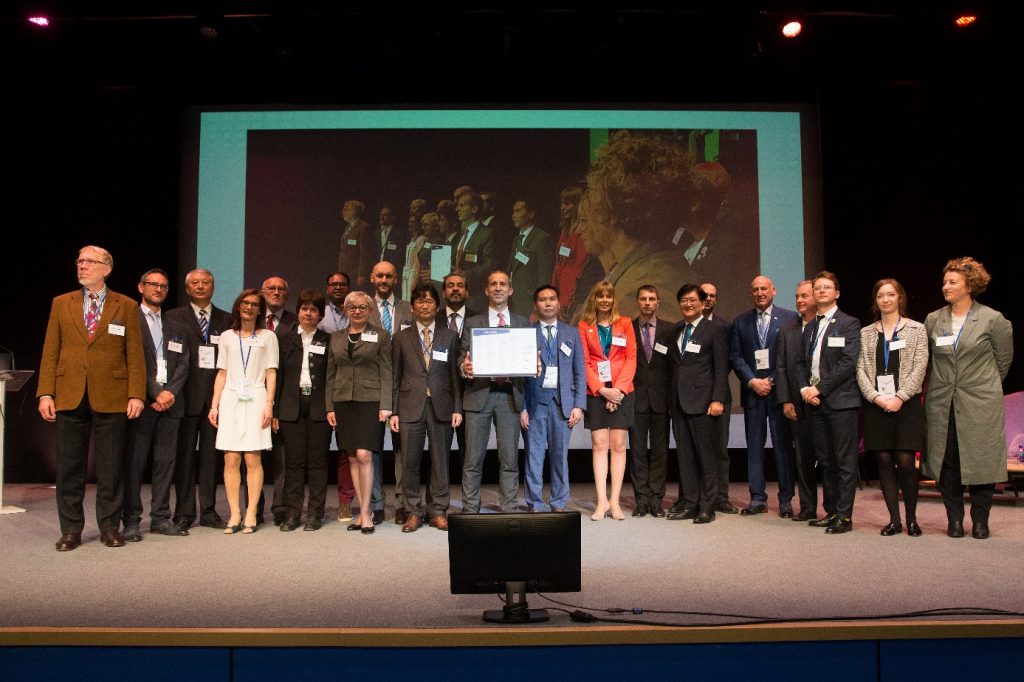
INSC Workshop, September 16, 2026
Dear INSC Members,
I would like to share a concise overview of the presentations delivered during our INSC Workshop on September 16 at the 70th IAEA General Conference. Together, these presentations highlight how nuclear energy is evolving globally—and how nuclear societies are becoming essential infrastructure for this new phase of growth.
Global nuclear development is accelerating. Today, 441 reactors operate worldwide and 75 are under construction, supplying more than 20% of global low‑carbon electricity. Electrification driven by AI, data centers, transportation, and industrial demand is reshaping energy systems. As countries seek secure, stable, and decarbonized power, nuclear energy has returned to the center of long‑term energy strategy.
Japan’s White Paper on Nuclear Energy underscores the importance of safety, transparency, and public trust. The report highlights Japan’s progress in Fukushima reconstruction, advanced reactor development, nuclear fuel‑cycle modernization, and international cooperation with the IAEA and partner countries. It emphasizes that nuclear technology supports not only energy security but also medicine, agriculture, industry, and scientific innovation. Japan’s experience demonstrates that long‑term nuclear success requires strong regulatory institutions, continuous safety improvements, and proactive public communication.
Latin America is entering a nuclear renaissance. Severe hydropower shortages and rising electricity demand have prompted countries such as Colombia, Ecuador, Peru, and El Salvador to develop SMR roadmaps and regulatory frameworks. Multilateral development banks have lifted restrictions on nuclear financing, making SMRs a practical entry point for newcomer nations.
Canada demonstrates nuclear as a strategic asset. With strengths across the full value chain—uranium mining, fuel fabrication, CANDU technology, SMR development, operations, and waste stewardship—Canada contributes significantly to continental energy security. The Canadian Nuclear Society emphasized that sustaining this advantage requires continuous knowledge transfer, workforce development, and public trust.
WiN Global highlighted inclusion and trust as core infrastructure. With 730 million people still lacking electricity access and women representing only 18.3% of senior nuclear leadership, the sector must broaden participation to sustain long‑term growth. Women in Nuclear, Young Generation Networks, and national societies play vital roles in capacity building, cross‑border learning, and public engagement.
ENS provided a comprehensive view of Europe’s nuclear landscape. Europe operates 126 reactors (98 in the EU), supported by 500,000 skilled workers, 87 long‑term operation units, and 36 research reactors. Europe leads globally with 21 SMR concepts headquartered across the region. EU climate policies, electrification targets, and energy‑security initiatives—including efforts to diversify nuclear fuel supply—underscore nuclear’s central role in Europe’s future energy mix. ENS also showcased strong youth engagement, education outreach, and advocacy through the Nuclear for Climate initiative.
Across all presentations, a unified message emerges: Nuclear societies are now strategic infrastructure for global nuclear development. They enable knowledge transfer, workforce mobility, supply‑chain coordination, evidence‑based public communication, leadership diversity, and support for newcomer countries building regulatory and operational capacity.
As the global umbrella for nuclear societies, INSC is uniquely positioned to integrate and amplify these efforts. Thank you for your continued commitment to INSC’s mission. We look forward to working closely with all of you as we support a resilient, inclusive, and globally connected nuclear future.
Warm regards,
羅彩月 Tracy, Tsaiyueh Luo
Chair, International Nuclear Societies Council (INSC)
Tracy, Tsai-Yueh Luo PhD
Presentation Materials
Last modified November 16, 2026, 10:33am CST